"A 12-year-old Latino boy arrived at a
Boston emergency department with dizziness and a headache. The patient, whom
I'll call Raul, had limited proficiency in English; his mother spoke no
English, and the attending physician spoke little Spanish. No medical
interpreter was available, so Raul acted as his own interpreter.
His mother described his symptoms:'La semana pasada a el le dio mucho mareo y no tenía fiebre ni
nada, y la familia por parte de papá todos padecen de diabetes.' (Last
week, he had a lot of dizziness, and he didn't have fever or anything, and his
dad's family all suffer from diabetes.)
'Uh hum,' replied the physician.
The mother went on. 'A mí me da miedo porque el lo que estaba mareado, mareado, mareado
y no tenía fiebre ni nada.' (I'm scared because he's dizzy, dizzy,
dizzy, and he didn't have fever or anything.)
'Turning to Raul, the physician asked, 'OK, so
she's saying you look kind of yellow, is that what she's saying?'
Raul interpreted for his mother: 'Es que si me vi amarillo?'(Is it that I looked yellow?)
'Estaba como mareado, como pálido' (You were like dizzy, like pale), his mother
replied.
Raul turned back to the doctor. 'Like I was like
paralyzed, something like that,' he said."
The Bilingual Endorsement Program for Physician Assistants
"Interpreting the Future of
Health Care"








======================================================================
Data on language barriers in health care
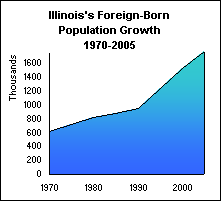
Over forty-six million Americans do not speak English as their primary language, while twenty-two million Americans have limited English proficiency, also referred to as LEP. LEP is described by the Federal Interagency Working Group on Limited English Proficiency as "individuals who do not speak English as their primary language and who have a limited ability to read, speak, write, or understand English can be limited English proficient, or 'LEP.' These individuals may be entitled language assistance with respect to a particular type of service, benefit, or encounter." In 2007, the United States Census Bureau that 2,603,244 people spoke a language other than English at home in Illinois, while 1,177,007 people spoke English less than "very well." Despite recession and decreasing rates of undocumented immigration in other parts of the country such as Arizona and California, illegal immigration rates in Illinois have been steadily increasing. By 2050, it is estimated that roughly half of the U.S. population will be compromised of minorities, with any equal increase in the number of individuals who speak a language other than English at home. The graph below indicates the growing numbers of foreign-born residents in Illinois since the 1970s.
Executive Order 13166, enacted in 2000, called for "Improving Access to Services for Persons with Limited English Proficiency." However, language barriers and medical interpretation errors continue to plague the United States health care system. When LEP patients fail to get interpreters, quality of care is automatically compromised, with quality of care for LEP patients already being inferior to begin with. Untrained or poorly trained interpreters also negatively impact health care quality, particularly in terms of the number of errors committed. Studies have found that ad hoc interpreters may average about 31 errors per clinical encounter. These errors are distributed as follows:
- 52% were omission errors
- 16% were false fluency
- 13% were substitution
- 10% were editorialization
- 8% were addition
Furthermore, 63% of errors resulted in potential clinical consequences. On average, 19 such errors occurred per encounter, and included errors such as leaving out questions related to drug allergies and omitting antibiotic instructions. An important point to note is that ad hoc interpreters were much more likely to make errors that resulted in potential clinical consequences than were hospital interpreters.
Certified medical interpreters can be the answer for many when it comes to language barriers in health care. However, in addition to medical interpreter services representing an added expense at about $279 per person per year, their presence does not replace the intimate patient-provider relationships that many patients desire when seeking care. Researchers from the Center of Health Policy Research at the University of California Irvine School of Medicine studied 2,700 LEP patients. The study found that language barriers were linked with decreased health education, poor patient-provider interactions, and overall decreased patient satisfaction. Furthermore, the study found that the presence of an interpreter did not compensate for having a shared common language. Those patients who were able to directly verbally communicate with their physicians were most satisfied with the quality of their care. Dr. Quyen Ngo-Metzger, as assistant professor of medicine at the university, was quotes as saying, "While interpreters are a necessary solution to the problem of language barriers in healthcare, our findings suggest they are likely to be an imperfect one. It remains important that our healthcare system recruit and train more bilingual providers to meet the needs of an increasingly diverse population."
======================================================================
Data on Physician Assistants
According to the Illinois Academy of Physician Assistants, a Physician Assistant's scope of practice includes the following:
- Obtaining medical histories
- Performing physician examinations
- Ordering or performing diagnostic tests and obtaining laboratory results
- Diagnosing and treating common medical problems
- Assisting in surgery
- Administering emergency care
- Prescribing uncontrolled substances and controlled substances Schedule III-V
Thus, Physician Assistants play a critical role in our health care system. Furthermore, they work in a wide variety of health care environments, including hospitals, private offices, nursing homes, health maintenance organizations, urban/rural satellite clinics, industrial clinics, correctional institutions, and veteran's administration and military facilities. Physician Assistants work under the guidance of physicians to provide a larger array of health care services. The presence of Physician Assistants also allows for greater accessibility to health care services, especially in underserved regions. Since a physician's time is often severely limited, the presence of Physician Assistants allows for reductions in waiting times and allows for an increased allowance of time for patients to ask questions and for Physician Assistants to provide guidance and education to patients, resulting in increased patient compliance and understanding. Thus, the employment of Physician Assistants helps decrease the cost of health care.
======================================================================
Data on the health care cost of errors related to language barriers
Although it is difficult to estimate yearly costs of medical errors associated with language barriers or interpreter errors, the cost is unquestionably high and takes a substantial financial toll on our health care system. Multi-million dollar lawsuits have resulted from simple linguistic mistakes or misunderstandings. For instance, in one notable case, doctors misinterpreted the Spanish work "intoxicado," which refers to having a sick feeling in the stomach, to mean "intoxicated," and ultimately the patient ended up with a preventable case of quadriplegia. The malpractice settlement was $71 million.
In other cases, lawsuits are related to the issue of informed consent as it relates to language barriers. In one example of a young boy who had lost the use of his right arm due to a broken elbow and required surgery to reduce the fracture, the family claimed that they were not informed by the surgeon of the medical findings and there was no interpreter present to ensure informed consent of the surgical procedure. This case resulted in a settlement of $650,000 in damages and the payment of legal fees greater than $80,000.
Yet other settlement cases are the result of discrimination claims based on language barriers. A Spanish speaking pregnant woman had died as a result of pork tapeworm complications, and the deceased patient's husband filed a $3.25 million lawsuit on the basis of discrimination since the couple were denied proper interpretation services. The case was ultimately dismissed, but $40,000 in legal fees had to be paid by the Carrier.
Inadequate documentation errors from language barriers also result in a high level of lawsuits. For instance, in the case of a Cantonese-speaking patient, the medical records just indicated that the patient was either from Hong Kong, Macau, or Saigon, which prevented the proper identification of an interpreter since it was unclear whether the needed language was Vietnamese or Cantonese. The lawsuit resulted in a $105,000 settlement and $27,000 paid in legal fees by the Carrier.
Numerous cases such as these exist which arise from a wide array of errors associated with language barriers and cost the health care system a substantial amount of money. Most of these cases are preventable if proper, and simple, language services would have been provided.